Before the Scrapbook: How People Kept Personal Memories
How people kept personal memories varied by format: learn what notebooks, albums and keepsakes preserve, and choose a form that suits what you want to remember.
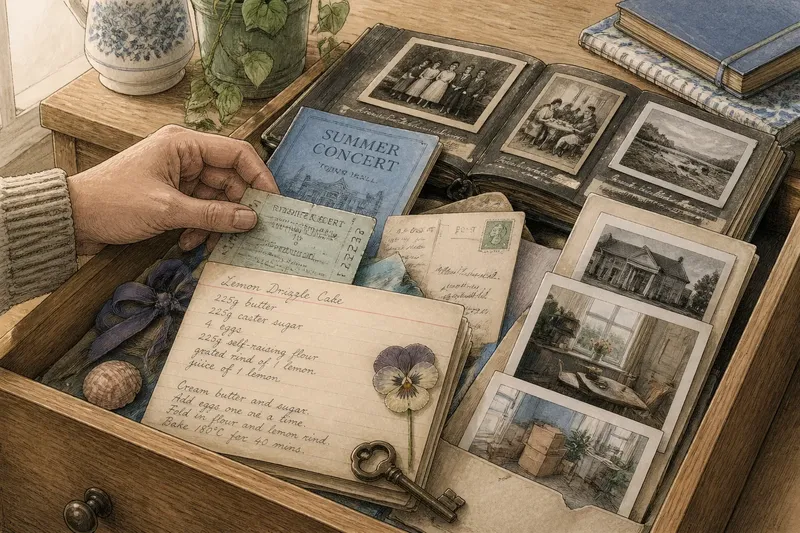
A folded train ticket lies in a kitchen drawer beside a recipe card written in a familiar hand. For anyone wondering how people kept personal memories, such small, surviving objects offer a starting point: a memory might live in a notebook, an album, a saved paper scrap or, now, a folder of images.
Imagine Mara, sorting family papers after a move. She comes across handwritten verses, a photograph album, a concert programme and digital pictures she has not opened in years. Rather than make one complete archive, she considers what each form lets her remember—and what it cannot tell her.
Commonplace books
A commonplace book gathers passages, observations, recipes and other chosen fragments in a notebook. Unlike a diary, it need not follow the order of a day or a life; its pages can reflect a keeper’s interests and associations.
Mara finds one among her grandmother’s papers. It holds a cake recipe, a pressed flower, several quotations and a reminder about a neighbour’s garden. Those entries do not provide a continuous account of her grandmother’s life, but they record particular things she chose to retain.
Mara copies the recipe card into her own notebook and adds what she knows about the relative who made it. She leaves the remaining pages blank for now. The result is a collection with room for later additions, rather than a record forced into a tidy sequence.
Photograph albums
An album places photographs in an order chosen by its keeper. A sequence of gatherings, holidays or portraits can suggest a story, though the arrangement is only one way of reading the images.
Mara’s family album contains posed portraits and celebrations but few ordinary afternoons. Handwritten names help identify some faces, yet they do not explain what mattered about every occasion. The album preserves selected scenes, not a complete account of the time between them.
She puts two loose photographs in a paper sleeve and writes down the names and place she recognises. She adds that she does not know the occasion. This keeps what she knows beside the images without turning uncertainty into a confident caption.
Objects and context
A ticket, shell, ribbon or key may be kept because it was present at a particular moment. On its own, an object offers little explanation; a note or remembered account can supply context, while still leaving room for doubt.
Mara finds a faded programme from a small music performance. It names the venue and performers, but not why her aunt saved it. Mara has heard a family story about the evening, though she cannot recall its details, so she records that the connection comes from a story remembered indirectly.
That small qualification matters. The programme can prompt a memory, but it cannot establish every detail of the evening. A brief note about where an object came from, and what its keeper does or does not remember, gives a later reader a more honest starting point.
Digital keepsakes
Digital photographs are easy to gather, but a folder of images may be hard to understand if names, dates or accompanying messages are missing. A few descriptive file names and a short note can make the relationship between pictures clearer.
Mara chooses three images connected to the papers: a kitchen photograph, a picture of the concert venue and a snapshot from moving day. She gives the files plain names and places copies in a folder with a text note explaining the links she sees. She leaves the original images in her existing library, so the curated folder offers one route through them without replacing their wider context.
A worked arrangement
Say Mara has a postcard from her aunt, no date on it, and only a hazy memory that it arrived after a family visit. She writes the aunt’s name, the postcard’s visible place name and her uncertain recollection on a notebook page. She then puts the postcard in a sleeve behind that page, without assigning a date.
The resulting arrangement keeps the original card with the facts and uncertainty Mara can currently supply. A later relative can read the message and see which part of the account is remembered rather than written on the card; the trade-off is that the date remains unknown instead of being guessed.
Small decisions
- Check whether a loose photograph has names written on its back; if they are legible, copy them into a note, but if not, mark the people as unidentified rather than guessing.
- Check whether a date appears on a ticket or programme; if it does, record it with the item, but if it does not, leave the date blank or mark it unknown.
- Check whether a notebook fragment has a clear source; if it does, name the book or person you can identify, but if it does not, preserve the wording without inventing an attribution.
- Check whether several photographs belong together through a shared place or occasion; if that link is clear, group them with a short note, but if it is uncertain, keep them separate.
- Check whether a digital file has a descriptive name; if it does, retain it, but if it does not, rename a copy with the subject or place you can identify.
- Check whether an object’s story comes from direct knowledge or someone else’s account; if you know its source, record that distinction, but if you do not, describe only the object and leave its history open.
What is not worth the effort is making every scrap equally important or designing a complicated filing system before you know what you want to revisit. Mara leaves unidentified papers alone. Her collection gains clarity from the notes she can support, not from filling every gap.
Questions about keepsakes?
What is a commonplace book?
A commonplace book is a notebook for passages, observations, recipes and other chosen fragments. Its entries can be grouped by interest or association rather than recorded in daily order.
How is an album different from a scrapbook?
An album often arranges photographs or other items in a sequence, while a scrapbook commonly combines varied paper pieces, captions and decoration. The forms can overlap; the keeper’s arrangement shapes how the pages read.
How should I label an inherited photograph?
Write down names, places and details you can identify, and mark uncertain information as uncertain. If family memories conflict or the picture raises a significant archival question, ask a qualified archivist for guidance.
What makes a digital collection easier to revisit?
Descriptive file names, a simple folder structure and a note about why images belong together can restore context. Keeping curated copies alongside the original library preserves both a chosen grouping and the broader collection.
Memory and form
Mara’s papers now include a notebook, a sleeve of photographs, a labelled envelope and a digital folder. Each form holds something different: words carry her notes, an album offers a visual sequence, an object retains its material presence and a folder brings related images together. How people kept personal memories has varied with the forms at hand and the choices each keeper made about what to save.
She leaves a blank page at the back of her notebook. It does not need to be filled to make the collection useful; if a new detail comes to mind, she can add it, and if none does, the page can remain open.